
Introduction: The Majesty of Galicia’s Ultimate Comfort Food
Picture a cold, misty afternoon in northwest Spain, where the air smells of slow-cooked pork, earthy greens, and rich broth that has been quietly bubbling for hours. That is the world of Cocido Gallego, a dish built for winter, family gatherings, and long, satisfying meals that stretch across the afternoon.
Now here’s the problem. When you search for the best cocido gallego near me, most results will point you toward generic Spanish restaurants. Many of them serve tapas, paella, or simplified stews that barely resemble the real thing. A true cocido gallego is not something you improvise—it’s a deeply traditional, labor-intensive feast rooted in centuries of rural cooking.
This guide gives you a complete roadmap. You’ll learn what authentic cocido gallego really is, how it differs from similar dishes, how it should be served, and—most importantly—how to find a restaurant near you that respects the tradition instead of cutting corners.
Culinary Anthropology: What Exactly is Cocido Gallego?
Cocido Gallego is not just a recipe—it’s a reflection of Galician history. It comes from a culture where nothing was wasted, especially during winter. Families relied on preserved pork from the seasonal pig slaughter, known as matanza, and combined it with hardy vegetables and legumes to create a meal that could feed many.
This is a winter Spanish comfort food at its core. It’s traditionally prepared during the colder months and is especially associated with Carnival season (Entroido). The dish is heavy, nourishing, and designed to keep you full and warm.
The Critical Distinction: Caldo vs Cocido
Many people confuse cocido gallego with caldo gallego, but they are fundamentally different.
- Caldo Gallego is a light, brothy soup made with greens, potatoes, beans, and a touch of pork fat (unto). It’s simple and eaten regularly.
- Cocido Gallego is a multi-component feast, where ingredients are cooked together but served separately in structured courses.
If you are served a single bowl of soup and told it’s cocido, you are not getting the authentic experience.
The Anatomy of Authenticity: Uncompromising Ingredients
Authentic cocido gallego is defined by its ingredients. Each one plays a specific role, and substitutions often signal a shortcut.
The Star Green: Grelos vs. Repolo
The defining green is grelos, or turnip tops harvested just before flowering. They bring a slightly bitter, sharp flavor that cuts through the richness of the pork.
Cabbage (repolo) can appear, but if a dish lacks grelos entirely, it loses its Galician identity.
The Pork Cult (The Meats)
Cocido gallego revolves around pork—specifically cured and salted cuts that require careful preparation.
Key components include:
- Lacón (cured pork shoulder)
- Chorizo gallego (paprika-heavy sausage)
- Costilla (ribs)
- Cachucha (pig’s head or snout)
- Orella (pig’s ear)
These cuts are not used casually. They must be desalted for 24 to 48 hours before cooking to balance the flavor.
The Binding Agents
Two elements hold the dish together:
- Garbanzos (chickpeas): Soaked for at least 12 hours before cooking
- Waxy potatoes: They absorb flavor without breaking apart
These are not optional—they form the structural base of the dish.
The Secret Ingredient: Unto
Unto is cured pork fat that melts into the broth, giving it a silky texture and signature depth. It’s subtle but essential. Without it, the dish feels incomplete.
The Ritual: How Authentic Cocido Gallego is Served
A real cocido gallego is not served in one bowl. It follows a three-stage ritual, and each stage builds on the last.
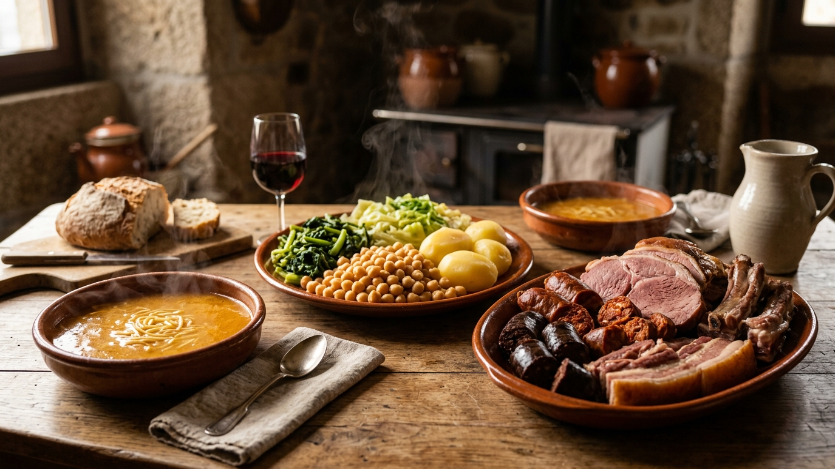
First Course: Sopa de Cocido
The meal begins with a rich, golden broth strained from the cooking pot. It’s often served with fine noodles (fideos). This is your introduction to the depth of flavor created by hours of slow simmering.
Second Course: Vegetables & Legumes
Next comes a large platter of:
- Chickpeas
- Potatoes
- Grelos
Everything is tender, infused with flavor, and slightly glossy from the broth.
Third Course: The Meats
Finally, the star attraction arrives—a generous platter of sliced meats including lacón, chorizo, ribs, and traditional cuts like ear or snout.
This course is rich, intense, and meant to be shared.
Local Playbook: How to Find the “Best Cocido Gallego Near Me”
Finding authentic cocido gallego requires strategy. It’s not about distance—it’s about accuracy.
The Naming Convention Rule
Avoid generic searches like “Spanish food near me.” Instead, look for:
- Galician restaurants
- Taberna Galega
- Pulpería
- Centro Galego
These places are far more likely to serve traditional dishes.
The Calendar Strategy
Cocido is not made on demand. Because of long preparation times, authentic restaurants:
- Serve it on specific days (often Sundays)
- Offer it as a seasonal winter special
- Require advance reservations for groups
If a place offers it every day instantly, that’s a red flag.
Review Scraping Tactics
Don’t just read ratings—search inside reviews. Look for mentions of:
- “grelos”
- “lacón”
- “authentic”
- “huge portions”
These keywords reveal whether the dish is genuine.
Authentic vs. Imitation: Quick Spotting Table
| Authentic Cocido Gallego | Tourist Trap / Generic Version |
|---|---|
| Served in multiple courses | Served as one soup |
| Includes grelos | Uses spinach or random greens |
| Features lacón and pork cuts | Only basic meat pieces |
| Limited availability | Always on the menu |
| Requires long prep | Quick, mass-produced |
The Regional Rivalry: Galician vs. Madrileño vs. Lebaniego
Understanding regional differences helps you avoid confusion.
Cocido Madrileño (Madrid)
This version includes:
- Beef shanks and bones
- Morcilla (blood sausage)
- Sweet cabbage
- Stuffed dumplings (pelota)
It’s heavier on beef and has a different flavor profile.
Cocido Lebaniego (Cantabria)
This lesser-known version uses:
- Small chickpeas (pedrosillanos)
- Mountain meats and game
It’s more rustic and regional.
Cocido Gallego
Defined by:
- Pork dominance
- Grelos bitterness
- Use of unto
- Clean, rich broth
Once you know these differences, it becomes easy to identify what you’re being served.
Conclusion & Foodie Call to Action
Tracking down the best cocido gallego near me is a rewarding journey for any serious food lover. It’s not just about finding a meal—it’s about discovering a tradition that has been preserved through generations.
The key is patience and awareness. Look for the right ingredients, understand the serving ritual, and always verify availability before you go. Call ahead, ask questions, and don’t settle for shortcuts.
When you finally sit down to a true cocido gallego, you’ll know instantly—it’s not just food, it’s a celebration of Galicia on a plate.
